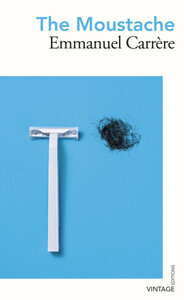
Right, new year, new start – or at least, the start of getting back into reading. This 1986 novel begins with a small change that becomes all-consuming. “What would you say if I shaved off my moustache?” the protagonist asks his wife Agnes. “That might be a good idea,” she replies, laughing.
The man goes ahead and shaves his moustache, but is annoyed to find that doing so has left behind a conspicuous patch of pale skin in contrast with his tan. He’s surprised that Agnes doesn’t seem to notice, and even more so when their friends Serge and Veronique don’t say anything at dinner that evening.
Thinking that Agnes must be playing a prank, the man questions her, and she insists that he has never had a moustache. He grows ever more desperate in his attempts to prove that his perception is right, and in imagining the elaborate deceptions that he believes Agnes must have arranged. The stakes grow higher when Agnes denies knowing Serge and Veronique, and it looks as though the man may have lost all grip on reality.
Carrère keeps the narration tightly bound to his protagonist’s viewpoint – not so much that it can’t be questioned, but enough that its momentum does not let up. The ending is perhaps the protagonist’s ultimate attempt to assert the validity of his perception. I don’t know that I was drawn in enough for The Moustache to have its full effect on me, but it was quite the journey.
Well, this turned out to be quite a page-turner. From one angle, that’s not so surprising, as there’s plenty of suspense in the set-up. In rural France, artist Christine has been receiving threatening letters. Her neighbour Patrice is getting ready to celebrate his wife Marion’s fortieth birthday. But some mysterious figures are watching, waiting to intrude on the party.
In other ways, The Birthday Party might seem the opposite of a page-turner, because it’s slowly paced and densely written. For example, here is Patrice trying not to contemplate that Marion may be unhappy in their relationship:
…he doesn’t think to himself that his wife goes out of her way to come home late, as though trying to avoid the moment where it’s the three of them together, no, he pushes away this thought that sometimes tries to force its way past the barrier he’s built up against it, a fraction of a second every night, sometimes more than a second, a few seconds, then, when the thought gets loose and spreads across his mind, but each time he rejects this bad, this acid idea that would have Marion go out of her way to come home as late as possible, no, that’s not true…
translation from french by daniel levin becker
I love the rhythm of this writing, a fine translation. Mauvignier’s prose combines this constant flow of interiority with sudden interruptions of action, and this technique is what makes the novel so propulsive for me. There are secrets and turns throughout, right up to the end – and we’re kept so close to the characters, too.
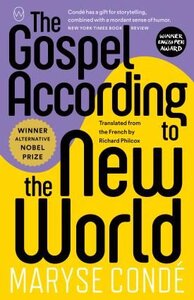
At 86, Guadeloupe-born Maryse Condé is the oldest author ever to be longlisted for the International Booker Prize. She says The Gospel According to the New World will be her last book, though it’s my first time reading her. I did wonder whether I was missing out somewhat in terms of not knowing about the themes and concerns across her work that led to this point, but I enjoyed my time with this book nonetheless.
Condé’s protagonist is Pascal, who is born in Martinique to a woman named Maya. Burdened by dreams that say her son will change the world, Maya abandons him at Easter, leaving him at the home of a couple who own a nursery (for plants) called the Garden of Eden.
Pascal’s life is then a parody of the gospels. He heads off in search of his origins , with rumours following him that he might be a new son of God. There are disciples, not-so-miraculous miracles, even a strange figure who might be an angel.
With everything he sees going on, Pascal begins to wonder: if he is to be a messiah, what is he “expected to do with this world streaked with bomb attacks and scarred with violence?” Then again, maybe the mantle of saviour doesn’t suit him anyway. Pascal’s story is told in a storyteller’s voice, the translation capturing that sense of truth in imagination.
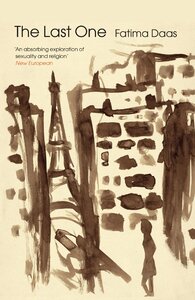
Who is Fatima Daas? Both a pseudonym and the main character of this novel. Fatima-of-the-novel is the ‘last one’ in her family, the only one born in France rather than Algeria, the third daughter her parents may not even have wanted.
I started with that question because the whole book represents Fatima’s reckoning with her self, the different parts of her identity. All of the chapters bar one begin with a declaration of her name and go on to depict an aspect of her experience, in writing that often echoes the rhythms of a prayer:
My name is Fatima.
I seek stability.
Because it’s hard to always be on the outside looking in, looking at people, never with them, your life passing you by, everything passing you by.
Translation from french by lara vergnaud
Within the pages of this book, we see Fatima as a daughter who feels she doesn’t belong in her mother’s kitchen; as a people-watcher on the train from the suburbs into Paris; as someone who lives with asthma. She’s a lesbian and a Muslim, and is searching for a way to reconcile the two. She enjoys the experience of visiting her family in Algeria, but still ultimately feels like a tourist.
All these different aspects of Fatima’s life jostle together in The Last One. By the end, there’s a sense that she is on the way to working things through and finding a place for herself.
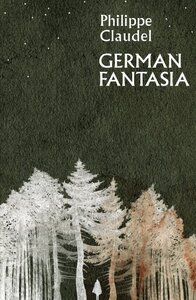
Is it really so long since I read Brodeck’s Report? I haven’t read Philippe Claudel nearly enough. His latest book in English translation is a cycle of five stories set in 20th century German, exploring themes of history, memory and complicity.
The opening ‘Ein Mann’ sets the tone. It sees a German soldier abandoning his post. We don’t know his name, and the landscape through which he travels is also largely anonymous. He’s been an unthinking cog in the machinery of the Nazi regime: “Was he guilty? Guilty of having obeyed? Or guilty of not having disobeyed? All he had done was follow. Did that make him less responsible than the others?”
Now that he sees what he has participated in, he wants to get away – he’s not really thinking about where, as long as it’s somewhere else. The ending of the story suggests, however, that he can’t outrun the past.
Recurring throughout the book is the name of Viktor, who may or may not be the same character each time, but always seems to have been an active participant in atrocity. In ‘Ein Mann,’ he’s in charge of the soldier’s concentration camp. In ‘Irma Grese’, though, he’s an old man in a care home in the 1990s, albeit with a past in the regime.
Irma herself is a girl who’s been given a job in the care home, part of which is specifically to look after Viktor, who happens to be the mayor’s father. Irma resents the job, and resents the pitiful Viktor. She takes out her frustrations on him by eating his food and mistreating him other ways. In an inversion of ‘Ein Mann’, the Viktor of ‘Irma Grese’ is victim rather than oppressor now. But, as Irma will find, there are no real winners in these stories, not in the face of the cruelty that flows through the book.
Elsewhere, Claudel explores the fallibility of memory. In ‘Sex und Linden’, an 90-year-old man looks back on his adolescence, and a time when he was seduced by a beautiful woman who kept whispering another man’s name (‘Viktor’, as it happens). It all sounds a bit too good to be true, and along with the man’s happy memory is a sense that the golden past can’t be recaptured, if it was there in the first place.
‘Die Kleine’ is the story of a young Jewish girl who has been rescued from a concentration camp, and taken to start a new life in a new household. She pictures the elements of her old life wrapped up in a handkerchief, but this memory is precarious. First, she recalls the old elements in a different way each time. Later, they start to lose their vibrancy:
The handkerchief, folded and tidied away in her brain, held many things but they were things that no longer moved, the way that clothes that have lost the bodies that used to inhabit them still keep a trace of their shape and their smells, but not much. Everything the little girl kept in the handkerchief reminded her of what had happened before, and over there. But over there was gone. There was only here.
The story which I found to lay down the greatest challenge to the reader was ‘Gnadentod’ – not in the sense of ‘difficulty’ but in its degree of confrontation. In this story, Claudel imagines a version of history in which the German artist Franz Marc did not die in 1916 at Verdun, but was instead placed in an asylum and subjected to a ‘mercy killing’ (to translate the story’s title) by the Nazis in 1940 due to his mental health.
Then again, maybe that’s just the official line. In one startling sequence, Claudel has Marc’s real-life biographer defending his scholarship in the face of the story’s prevailing fiction. This is a stark experience because we’re seeing fake history being created before our eyes and paraded as the truth.
In various ways throughout German Fantasia, Claudel illustrates how history and memory can be distorted (deliberately or otherwise). He also suggests that his characters are caught in the shadow of German history, no matter where or when they are.
If 2022 has taught me anything with regard to reading, it’s that I shouldn’t bother with firm reading plans! Over the year, I was a little frustrated that I couldn’t seem to get into my usual reading routine. I also had a sense that some of my reading cornerstones (such as the Goldsmiths Prize) weren’t chiming with me as they usually did. Whether that’s just a blip or a broader change in my taste, I’ll gain a better idea next year.
Whatever the case, I still read some grand books this year. Here is my usual informal countdown of the dozen that have flourished most in my mind:
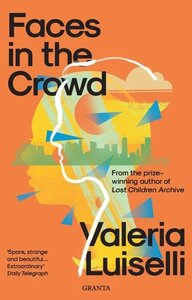
12. Faces in the Crowd (2011) by Valeria Luiselli Translated from Spanish by Christina MacSweeney (2014)
My chance to catch up on a book I’ve long wanted to read, and it was worth the wait. A young woman’s life in Mexico City contrasts with her old life in New York, and with the novel she’s writing, and the life of the poet she’s writing about… Different, blurred layers of reality make this such a rush to read.
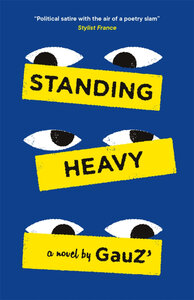
11. Standing Heavy (2014) by GauZ’ Translated from French by Frank Wynne (2022)
A novel about the changing experiences of Ivorian security guards in Paris, Standing Heavy is intriguingly pared back in its form. Three story-chapters capture the movement of history around the characters, and more fragmented observations deepen one’s sense of the book’s world. This is a short novel with a lot to say.
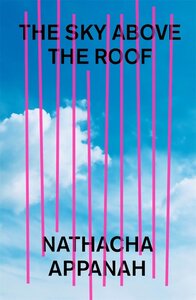
10. The Sky Above the Roof (2019) by Nathacha Appanah Translated from French by Geoffrey Strachan (2022)
This was a fine example of how a novel’s brevity can bring a distinctive atmosphere to familiar subject matter. Appanah focuses on a young man who’s been apprehended after a road crash, as well as his sister and mother – all three of them ill at ease with the world. This novel has an intensity that might easily be diluted in a longer work.
9. The Proof (1988) and The Third Lie (1991) by Ágota Kristóf Translated from French by David Watson (1991) and Marc Romano (1996)
These two novels follow on from Kristóf’s The Notebook: I read them together, and they belong together here. Kristóf’s trilogy tells of two brothers displaced by war. There’s great trauma in the background, but emotions are kept distant. Geography and time are also flattened out, adding to the feeling of being trapped. The trilogy progressively undermines any sense of understanding the truth of what happened to the brothers, and therein lies its power for me.
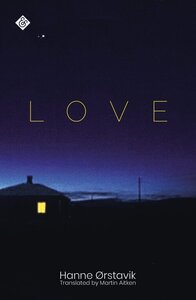
8. Love (1997) by Hanne Ørstavik Translated from Norwegian by Martin Aitken (2018)
This novel is about a mother and son who live in the same space yet still in their own worlds. That theme is strikingly reflected in the writing, as the two characters’ stories merge into and out of each other repeatedly. Often, the pair seem closest emotionally when they’re separated physically. The ending is sharp and poignant.
7. The Sons of Red Lake (2008) by Zhou Daxin Translated from Chinese by Thomas Bray and Haiwang Yuan (2022)
Breaking the run of short, spare novels is a longer one that I enjoyed taking my time over. A woman returns to her childhood village, falls back in love with her childhood sweetheart, and finds her fortunes changing for better and worse. Zhou’s novel explores the effects of tourism and the temptations of power. I found it engrossing.
Some of the best writing I read all year was in this book. It’s a novel following the life of an African American woman from Chicago. She has aspirations for herself, but the reality turns out to be rather mixed. In the end, I found hope in Maud Martha, as its snapshot structure opened up possibilities beyond the final page.
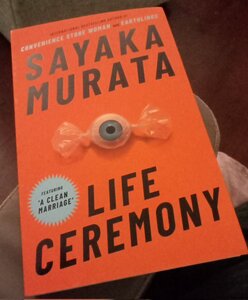
5. Life Ceremony (2019) by Sayaka Murata Translated from Japanese by Ginny Tapley Takemori (2022)
I’m not sure that anyone combines the innocuous and strange quite like Sayaka Murata. This story collection is typically striking, using larger-than-life situations to explore basic questions of what we value and how we relate to each other. Perhaps most of all, Murata puts her readers in the position of her characters, so we see them differently as a result.
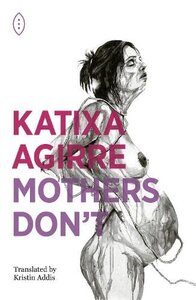
4. Mothers Don’t (2019) by Katixa Agirre Translated from Basque by Kristin Addis (2022)
Few books that I read this year made such an immediate impression as this one. Agirre’s narrator tries to understand why another woman killed her children, while trying to come to terms with her own feelings about motherhood. Contradictions abound and nothing is reconciled, and this is what drives the novel – not to mention its vivid prose.
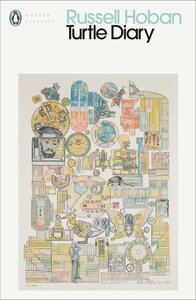
Russell Hoban was my discovery of the year, someone I know I’ll read again. Turtle Diary is the story of two lonely characters linked only by a wish to set free the sea turtles at London Zoo. I really appreciated the ambivalence of Hoban’s novel, the way that saving the turtles in itself isn’t enough to fill the hole in the characters’ lives. I simply haven’t read anything quite like this book before.
I loved this novel exploring the ramifications of new technology. Morgan imagines the development of a matter transporter and, step by step, puts humanity’s relationship with it under scrutiny. What is perhaps most chilling is the way that everything just trundles on, away from the people actually experiencing this technology. Appliance provides a welcome space for reflection.
nor
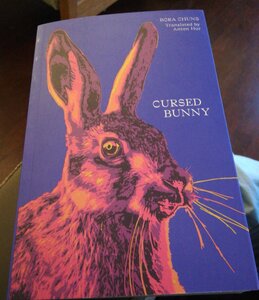
1. Cursed Bunny (2021) by Bora Chung Translated from Korean by Anton Hur (2021)
At the top of the tree this year is a story collection that grabbed my attention from the first page and never let go. Some of the stories are strange and creepy, others more like fairy tales. Many are built around powerful metaphors that deepen the intensity of the fiction. It’s all held together by Chung’s distinctive voice, in that wonderful translation by Anton Hur. I look forward to reading more of Chung’s work in the future.
With that, I will leave you until 2023. In the meantime, you can also find me on Twitter, Instagram, Facebook and Mastodon – and I’ll see you back here next year.
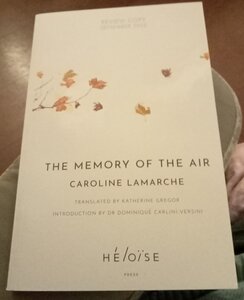
The Memory of the Air is a slim volume that confronts an assault, at first obliquely and later directly. Caroline Lamarche’s narrator begins dreaming of a dead woman in a ravine, and resolves to visit her regularly. It seems pretty clear that this is an internal journey for the narrator:
Every morning, I think that everything is going to be all right. Or, on the contrary, that everything is going to go wrong. Either way, I have to go for it: put one foot in front of the other. Depending on the day, the descent into the ravine can be more or less easy.
As the monologue flows back and forth between the narrator’s life and that ravine, we get a sense of her reality growing unstable. She tells us about her relationship with a man she refers to only as” the man before” or “Manfore”. Over time, we see how toxic – indeed, abusive – that relationship was. A remark from Manfore then takes the narrator back further, to finally face what happened to her in the past.
Katherine Gregor’s translation takes you right into the narrator’s perspective. Reading The Memory of the Air is an intense, harrowing experience.
Shawn the Book Maniac invited me back on his YouTube channel for another episode of Bite-sized Book Chats. This time we had a few words about Standing Heavy by GauZ’ (tr, Frank Wynne), the Ivoirian novel about security guards in Paris that I originally reviewed here on the blog. Check out our conversation below:
Ágota Kristóf (1935-2011) was a Hungarian writer who lived in exile in Switzerland, and wrote in French, In 2014, I read The Notebook, her novel about twin boys driven to acts of cruelty in wartime and after. The brothers don’t allow themselves to express emotion, and the specifics of geography and time are diluted. I found the effect powerfully austere.
The Notebook is a complete experience in itself, but it’s also the first part of a trilogy. I’d always intended to read the rest, and now I have. It’s interesting to see how each volume casts the previous one in a different light.
The Notebook ended with the brothers separated: one crossed the border into a neighbouring country, the other stayed behind. This was, in its way, impossible to imagine, as the boys had narrated as one ‘we’ throughout. The Proof (tr. David Watson) picks the story up with the brother who returned home. Now, we learn his name: Lucas. This alone makes him seem more human and approachable, and we see Lucas trying to adjust to life alone, developing relationships with others and becoming an adult.
But it’s not as simple as that. Kristóf’s prose is as sparse as in The Notebook, creating a stark emotional distance. Lucas is still capable of cruelty, and there are times when we sense he’s being deeply affected by all he has been through – but he won’t let it show, and we can’t get close enough to him to really understand how he feels.
Geography and time are again flattened out, which heightens the sense of being trapped: years pass, yet everything feels essentially the same. But things are about to change when Lucas’s brother Claus finally returns, and suddenly what we’ve read is called into question.
The Third Lie (tr. Marc Romano) goes even further in breaking identities down. At the start, it is narrated by Claus, then at times appears to be narrated by Lucas, and at other times it’s not clear at all. Scenes from The Notebook are retold in a different form that challenge our fundamental assumptions: were there ever two brothers at all?
What I get most from Kristóf’s trilogy as a whole is the sense of being ultimately unable to reach the truth of what happened to its characters. There is great trauma in the background, yet it’s all words on paper in the end – and that, to me, is what gives the trilogy its power.
This dramatic monologue is the follow-up to Darina Al Joundi’s The Day Nina Simone Stopped Singing, which I wrote about earlier in the year. Once again, the translator is Helen Vassallo of the excellent Translating Women blog.
In Marseillaise My Way, Al Joundi’s protagonist Noun has left Beirut to make a new life for herself in France. As in the earlier play, a song runs through the piece, representing Noun’s situation. Before it was Nina Simone’s ‘Sinnerman’, which underlined Noun’s complex relationship with her father. Here it’s the Marseillaise, which Noun has to be able to sing as part of her French citizenship test.
Noun is uneasy about the words and often sings off-key. This represents a wider ambivalence that she feels towards France. She chose France because she thought it was the kind of secular country where she could have the freedoms she was denied in Lebanon. Yet she sees women and girls in France choosing to wear the veil and burka, and she can’t understand why. Experiences like this lead Noun to reflect on the Arab women who fought for freedom in the past.
The obstacles to Noun gaining citizenship keep piling up, as she has to navigate a maze of bureaucracy. But she remains determined to get there, to sing the Marseillaise her way. Her story is compelling.





Recent Comments