Tag: Women in Translation Month

Women in Translation Month: Failed Summer Vacation by Heuijung Hur (tr. Paige Aniyah Morris)

Hello, it’s been a while. I have been taking a break from the world of blogging; hopefully now I can get back into it. August brings us Women in Translation Month, so here goes…

***

If one word comes to mind when I’m thinking about the stories in Heuijung Hur’s Failed Summer Vacation (translated from Korean by Paige Aniyah Morris), it is ‘disconnection’. Disconnection in the characters, yes, but also in the fabric of the stories themselves. 

My favourite story is ‘Imperfect Pitch’, which introduces us to Baek, who drifts through life and spends most of his time checking a fancafe for the titular rock band. The band are defunct, but the cafe just about keeps going. The story begins with Baek reading about the death of O, a long-time fan of Imperfect Pitch, and a driving force behind the fancafe. 

From there, the story splits into three strands: there’s the fancafe in the present day, where it becomes apparent that no one really knew O, despite her centrality. There is the time Baek went to Imperfect Pitch’s farewell show, buying a ticket from O and picking it up from a station locker, without ever meeting her. Further back, there is Baek’s discovery of the band at university, and the time he performed one of their songs at a student society concert. 

In each strand, we then see people ultimately failing to come together despite being in institutions meant to facilitate that (the fancafe, the student music club). Likewise, the three strands remain separate on the page, apart from a striking moment that merges Baek’s student performance with the final Imperfect Pitch show – and which highlights Baek’s isolation even back then. 

(An extract from ‘Imperfect Pitch’ is available on the Wasafiri website.)

Failed Summer Vacation is full of striking images and imaginative turns, leading to stories that don’t necessarily lend themselves to easy interpretation, but instead nag at the mind. A good example is ‘Loaf Cake’, which begins with the narrator’s partner (housemate? companion?) Sand leaving the house, after which she, the narrator, loses the ability to speak. 

The narrator then needs to find a new means of connection, and she begins to find this with a baker named Snow and his delicious creations, especially the loaf cake that the narrator devours each time she visits his shop. Then Sand returns, but he appears to have walked so far that his very self is crumbling away. It’s the images and sensations that linger longest: as so often in these stories, there’s the nagging sense that true connection lies just out of reach of Hur’s characters.

Failed Summer Vacation is published by Scratch Books.


A Challenge of Empathy: Convenience Store Woman by Sayaka Murata (tr. Ginny Tapley Takemori)

This review was first published at Splice in October 2018.

***

Meet Keiko Furukura. She has always found it difficult to conform to what her family and wider society consider “normal”. She once stopped a fight between a group of boys at primary school by hitting one of them over the head with a spade. She couldn’t understand what was wrong with this: “Everyone was saying to stop them, so that’s what I did,” she told her teachers. Throughout the rest of her childhood, Keiko kept her head down, saying no more than she had to — and the adults around her didn’t think that was normal, either. It wasn’t until she got a job at the Hiiromachi Station Smile Mart in 1998, whilst at university, that she felt she had finally found her place in the world. Eighteen years later, she’s still there.

Convenience Store Woman is Sayaka Murata’s tenth novel, but the first to appear in English (translated by Ginny Tapley Takemori). The title may appear prosaic, but it points towards the essence of Keiko’s situation by combining place and person to suggest something greater than the sum of both. Keiko really does live and breathe her job. The store’s sounds reverberate through her head as she falls asleep at night, and she imagines the cells of her body energised at the prospect of being there. Those cells are also made up of food from the convenience store because that’s all Keiko eats, and the thought of this makes her “feel like I’m as much a part of the store as the magazine racks or the coffee machine.”

Continue reading

Women in Translation Month: Jellyfish Have No Ears by Adèle Rosenfeld (tr. Jeffrey Zuckerman)

Meet Louise: she has used a hearing aid since childhood, but her ability to hear has now deteriorated so much that she faces the choice of whether to have a cochlear implant. The issue for her is that, if she does, she’ll lose what ‘natural’ hearing she already has, and the sound she hears will be mediated entirely through an electronic device. Louise wonders if that will change her as a person. Adèle Rosenfeld’s debut novel explores how Louise confronts the different possibilities.

Louise is depicted as effectively living between two worlds: not able to get by easily in hearing society, but also unable to embrace Deaf culture. The way she hears is also on a continuum, sometimes straightforwardly intelligible, but more often a fluid experience of sound that leans towards the abstract:

At the supermarket, the voices blurred into a single echo. An epidemic of sorts had spread across all sound: the jam jars that the stock boy was shelving chattered; the product codes’ beeps at the checkout seeped into the women’s stressed syllables like fantastical outbursts; the deli-counter machine let out a hoarse cough. At the checkout, I overheard “bulgur” or maybe “burer”. To a “you” – static – “there,” I answered yes twice without understanding, replied no three times without understanding, and finally declared “I don’t know,” still without understanding. 

Translated from French by Jeffrey Zuckerman

This experience extends to how Louise relates to other people. The other characters tend to feel as though they’re at arm’s length, even those closest to Louise, because she has to stretch to reach them. She imagines some characters, such as a soldier whose story springs forth from the words in an auditory test – and they become no less (or more) important to Louise’s experience of the world than ‘real’ people (if the reader can be sure which characters are real, that is).

For me, Louise’s dilemma is perhaps best summed up in the person of Thomas, her lover. On the one hand, he’s willing – more so than any other character – to accommodate Louise’s needs and desires; for example, he adjusts a music recording to make it more accessible to her hearing profile. On the other hand, Thomas is much more enthusiastic about the idea of a cochlear implant than she is. So, would Louise rather engage with the world from here, or step over there into the unknown? Either way, her journey is absorbing.

Jellyfish Have No Ears is published by MacLehose Press in the UK and Graywolf Press in the US.

In the Belly of the Queen by Karosh Taha (tr. Grashina Gabelmann): Women in Translation Month

In the Belly of the Queen is published as two novellas back-to-back, each set amongst the same group of characters in a Kurdish community in Germany. In my reading of the book, the two novellas don’t fit into the same chronology – but I have to sound a note of caution here, because I haven’t found another review online that thinks the same. If I’m wrong in what follows, so be it – I can only write about the book that I read. 

In each novella, the narrator is close to the character Younes. Raffiq (whose story I read first) can’t help thinking about Younes’s beautiful mother Shahira, who doesn’t conform to the community’s expectations – for example, she sleeps around and wears revealing clothes. The attention is too much for Younes, who goes to find his father in Frankfurt. Raffiq’s girlfriend Amal plans to go to America, and his father wants the family to leave for Kurdistan, where he’d be qualified to practise as an architect once again. Raffiq wants to stay in Germany, and has to decide where his loyalties lie. 

The other story is Amal’s, but here she is no friend of Raffiq. Like Shahira, this Amal doesn’t abide by societal expectations, albeit in a different way: from an early age, she was nicknamed “Mowgli-girl” for cutting her hair short and beating up Younes (they would become closer later on). In this account, Amal’s father is an architect who went back to Kurdistan; she follows him, but doesn’t find quite what she expected. 

By structuring her novel in this way, Taha effectively puts Raffiq and Amal in the same position in their respective stories, then explores the different ramifications for each. There’s also the character of Shahira, who looms large in both stories but never speaks to us herself (I have to acknowledge that the author’s essay in the book pointed me towards this). In a sense, she exists beyond the narrative in the same way that she exists beyond community norms. The full effect of Taha’s novel lies in the interplay and contrast between its two halves. 

Published by V&Q Books.

Violeta among the Stars by Dulce Maria Cardoso: Women in Translation Month

At the start of this novel, Violeta has accidentally driven off the road during a storm. Her car rolled down an embankment, and now she’s hanging upside down:

[…] the rain beats down on the car roof with a noise that should scare me, it thickens the car windows, doubles them, thousands of burst drops against the glass, watery webs torn apart by the wind, gusts of wind reaching speeds of up to, I defy the stormy night,

I drive through the darkness

my hand blindly seeking a voice that will calm the storm, lightning, a trace of light from the beginning, in the beginning there was only light, in the beginning there was only light and we were already blinded forever, 

Translation from Portuguese by Ángel Gurría-Quintana

This is what Violeta’s narration is like: fragmented, no full stops, frequent interjections, and often repeated phrases. It’s a superb translation by Gurría-Quintara, that throws you into the chaos of Violeta’s mind as she thinks over her life, looping back again and again. 

Violeta sells hair-removal products: she describes body hair as her enemy (partly because she’s ill at ease with her own body). On the particular day of her accident, Violeta had sold her deceased parents’ home, which didn’t go down well with her daughter Dora. As Violeta’s recollections go further back, we gain more context for her relationship with Dora, and see how her parents ended up on the wrong side of Portugal’s Carnation Revolution. 

By novel’s end, Violeta is facing up to the inevitable, and we’ve borne witness to a multifaceted view of her character and life. Cardoso’s telling makes Violeta seem a whole person to us, good points and bad. 

Published by MacLehose Press.

And the Bride Closed the Door by Ronit Matalon: Women in Translation Month

When it comes to an event like Women in Translation Month, I usually pick out a few titles in advance that I want to read. But I also like to leave some room for serendipity, like this Israeli novel. I found it while searching through a box of books, had no memory of it… Then I read the blurb, and wanted to read it straight away. 

(I’ve since worked out that I got it through an old Asymptote Book Club subscription.)

It’s supposed to be the day of Marie’s and Matti’s wedding, but there’s a problem: Margie has locked herself in her room, and is repeating “Not getting married” over and over again. The novel focuses on the couple’s families and their attempts to get through to Margie. 

There’s a wry sense of humour throughout Matalon’s book, and the imagery is often striking. For example, this is from the first couple of pages:

And so they simply continued to stare at the shut door with its old-fashioned dark wood veneer, seemingly anticipating a thawing, a softening, miraculous melting–if not of the bride then at least of the door–and hoping for something further: a continuation of the sentence [i.e. “Not gettiing married”], an idea or a word that might emerge through the door like the wet head of a newborn closely followed by the body itself sliding out.

Translation from Hebrew by Jessica Cohen

I found that comparison to a newborn baby quite startling, and a little uncomfortable, to imagine in context. The novel’s characters are similarly caught off-guard: the only real clue Margie gives them to her state of mind is a section of Lea Goldberg’s poem ‘The Prodigal Son’, adapted to become ‘The Prodigal Daughter’.

And the Bride Closed the Door was Ronit Matalon’s last novel, winning the Brenner Prize the day before the author died in 2017. Reading around a bit, it seems clear that there are reflections on Israeli society in the novel that I wouldn’t have picked up on. Even without that, I found Matalon’s book an intriguing and entertaining character portrait.

Published by New Vessel Press.

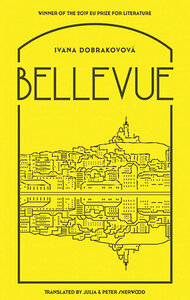
Bellevue by Ivana Dobrakovová: Women in Translation Month

The book and the reading both start out innocuously enough: Blanka, a young Slovak woman, takes a summer job in Marseille, at the Bellevue centre for people with physical disabilities. Her main reason for applying is the chance to practise her French in an immersive environment. She doesn’t really seem to have considered the work involved, and that’s where her problems start. 

The environment of Bellevue is indeed immersive, but not in the way Blanka may have been thinking. She really struggles to be around the disabled people at the centre, to cope with people unable to look after themselves. To an extent, she struggles to see them as people. 

There are gradual signs that Blanka’s mental health is being affected: a panic attack, then this… 

…deep inside I had always known it, sensed it, but now I could suddenly give it a name, was able to articulate it, the words now pounded right in my chest, we all hate each other, suddenly nothing but this truth, this knowledge, or rather the realisation that there’s nothing but hatred in this world, that to grow up means to understand and accept all the world’s hatred directed at every single person, and therefore also at me.

Translation from Slovak by Julia & Peter Sherwood

As the novel goes on, we come to understand more of Blanka’s background, and see her continue to unravel. This is particularly harrowing because Blanka doesn’t articulate what is happening to her. Dobrakovová (in the Sherwoods’ superb translation) shows it through the changing shape of Blanka’s language: her narration frays along with her mental state. We go directly to the heart of Blanka’s experience, and the effect is powerful. 

Published by Jantar Publishing.

The Last Quarter of the Moon by Chi Zijian: Women in Translation Month

I’ve had this book (originally published in Chinese in 2005) on my shelves for a few years, and finally took the time to read it. I’m glad I did. 

The Last Quarter of the Moon is set among the Evenki people, reindeer herders of north-eastern China. The narrator is a ninety-year-old woman, who doesn’t reveal her name because she doesn’t want traces of herself to be left behind. Most of her clan are moving permanently to the town, leaving their nomadic lives behind. She remains, telling her story to “the fire and the rain”. 

When the narrator is growing up, it’s clear how much her people’s lifestyle is shaped by the landscape:

But we were unable to leave this river. We always treated it as our centre, living alongside its many tributaries. If the Argun is the palm of a hand, then its tributaries are five open fingers. They extend in different directions, illuminating our lives like flashes of lightning. 

Translation by Bruce Humes

There are vivid descriptions of place throughout Chi’s novel. As a whole, the book is structured around changes in the narrator’s family, set against the broader movement of history and encounters with outside cultures. Throughout, there is the sense of just how precarious is the Evenkis’ traditional culture. The story always comes back to the personal, but Chi makes clear how much is really at stake. 

Published by Vintage Books.

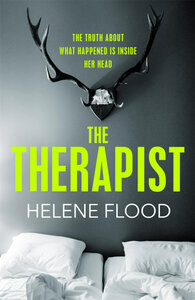
The Therapist by Helene Flood: Women in Translation Month

It’s August, which means Women in Translation Month, hosted by Meytal at BIblibio. This year I’m starting in Norway, with a splendidly twisty thriller translated by Alison McCullough. 

Psychologist Sara thinks nothing of it when her husband Sigurd leaves a voicemail letting her know that he’s arrived at the cabin for a holiday with his friends. She changes her mind when Sigurd’s friends ring her that night, wondering why he hasn’t turned up at the cabin. Then Sigurd’s body is found with two bullets in the back, and life will never be the same again. 

I enjoyed reading The Therapist, partly for the game of working out what’s really going on. This is well handled by Flood: I didn’t work it out, but with hindsight I feel I could have. Sara’s job also sets up a neat parallel: professionally, she tries to understand what people are thinking and why; now she’s having to do the same with someone close to her. It’s well worth going along on the journey. 

Published by MacLehose Press.

The Castle of Whispers – Carole Martinez

It’s time for some historical fiction, the second novel by French writer Carole Martinez. In the late 12th century, Esclarmonde is the beautiful daughter of a lord; she faces marriage to the philandering Lothaire, scion of Montfaucon, but she knows that this will lead to an unacceptable loss of autonomy:

I would be nothing but a modest container whom successive pregnancies would finally carry away. And even if Lothaire died before me, my widowhood would not protect me, but would abandon me again to the highest bidder as a token of some alliance or other. 

(translation by Howard Curtis) 

There’s only one thing that Esclarmonde can think to do: at the wedding ceremony, she cuts off her ear and announces that she will dedicate her life to Christ as an anchoress. Her family’s seat, the Castle of Whispers, has been added to piecemeal over the generations; now her father adds the chapel in which Esclarmonde will be sealed for the rest of her days. She will be considered dead to the world, even receiving the rite of extreme unction.  

However, the night before her confinement begins, Esclarmonde is raped. In the following months, she falls pregnant and gives birth to a boy whom she names Ezléar, “God’s help”. She decides to keep the child, whose birth comes to be seen as miraculous (no one asks Esclarmonde the question that would reveal otherwise). Add to this that no one has been claimed by death since Esclarmonde entered her cell, and the Damsel of the Whispers’ reputation only grows. 

But although Esclarmonde’s godliness increases in the eyes of others, her own feelings are moving in a different direction:

Gradually, without my even noticing, my attention moved away from the hagioscope to my son and all the people he attracted. God occupied me less than his creatures from now, and I never grew tired of watching them, listening to them, trying to understand what motivated their little brains. I no longer dreaded their judgment, or even that of God. I had not lied, I had merely kept silent about a truth that nobody wanted to hear anyway, and my silence had offered a blank space to be embroidered, an emptiness that everyone had seized on with delight. 

Esclarmonde’s self-questioning over her faith is a recurring theme of The Castle of Whispers. Another is motherhood, and what Elzéar represents you Esclarmonde – whether she’ll be happy to surrender him to the outside world before he grows too large to fit through the window to her cell. A further theme is power: in a world ruled by men, Esclarmonde gains a certain amount of power through her status as an anchor essay. Later on in the novel, she convinces her father to join Frederick Barbarossa’s forces on the Third Crusade; the lord’s young wife Douce, Esclarmonde’s stepmother, rules at home in his stead. The book becomes an exploration of the shifting spaces of male and female power. 

I’m struck by how much The Castle of Whispers encompasses when its protagonist spends most of time confined to a small space. More than that, it’s thoroughly engrossing. After this, I’ll certainly be going back to look at Martinez’s first novel, The Threads of the Heart, and looking out for future books, too. 

Elsewhere 

Stu has reviewed this book over at Winstonsdad’s Blog

Book details 

The Castle of Whispers (2011) by Carole Martinez, tr. Howard Curtis (2014), Europa Editions, 194 pages, hardback (review copy). 

© 2025 David's Book World

Theme by Anders NorénUp ↑